
Most business owners figure out that an agency was the wrong choice around month three.
By that point, the contract is active, the budget is gone, and the results are either missing or don’t relate to what matters for the business. The relationship ends, sometimes on good terms and sometimes not, and the search begins again.
The frustrating part is that most of the signs were there before the contract was signed. They just weren't easy to recognise at the time.
I run a marketing agency, so I’ve seen this from the inside. I know what works and what doesn’t.
Here’s an honest look at what to watch for before you sign, and what it should feel like to work with a good agency.
Here’s an honest look at what to watch for before you sign, and what it should feel like to work with a good agency.
Table of contents:
- Red flag 1: They pitch before they listen
- Red flag 2: No KPIs are agreed before work starts
- Red flag 3: They guarantee results
- Red flag 4: Their reports focus on reach, impressions, and engagement
- Red flag 5: The person selling the work is not the person doing it
- Red flag 6: They cannot show you a case study with real numbers
- Red flag 7: There is a long lock-in with no review point
- Red flags in the agency contract
- Red flags by agency type: SEO, PPC, and branding
- The question to ask before every agency conversation
- A note on price
- If you are currently evaluating agencies
- Frequently Asked Questions
Red flag 1: They pitch before they listen
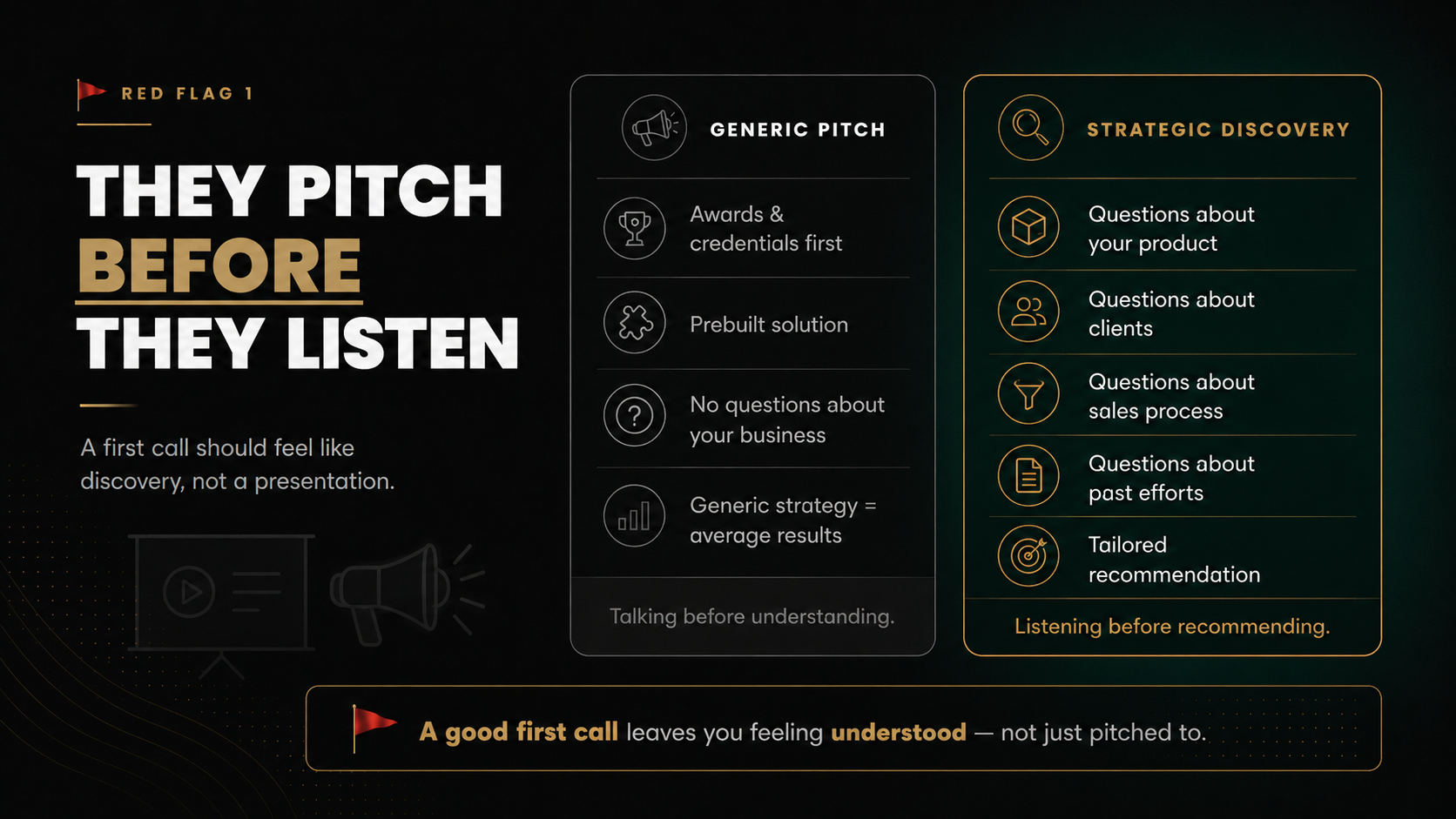
When you meet with a potential agency for the first time, it should feel like a focused conversation, not a formal presentation.
If an agency starts by showing off their awards, team size, and client list before asking anything about your business, that’s a red flag. It means they already have a solution in mind without first understanding your needs.
Effective marketing is tailored to each business. For example, a strategy that works for a SPA in Limassol won’t work for an immigration consultancy in London. Before an agency can recommend channels, budgets, or expected results, they need to learn about your product, your clients, your sales process, your past efforts, and where things have gone wrong before.
If these topics don’t come up in your first meeting, the agency’s strategy will likely be generic. And generic strategies usually only deliver average results.
A good first call is filled with questions from the agency. You should leave feeling truly understood, not just pitched to.
Red flag 2: No KPIs are agreed before work starts
This is the clearest early sign that an agency does not plan to measure its own work.
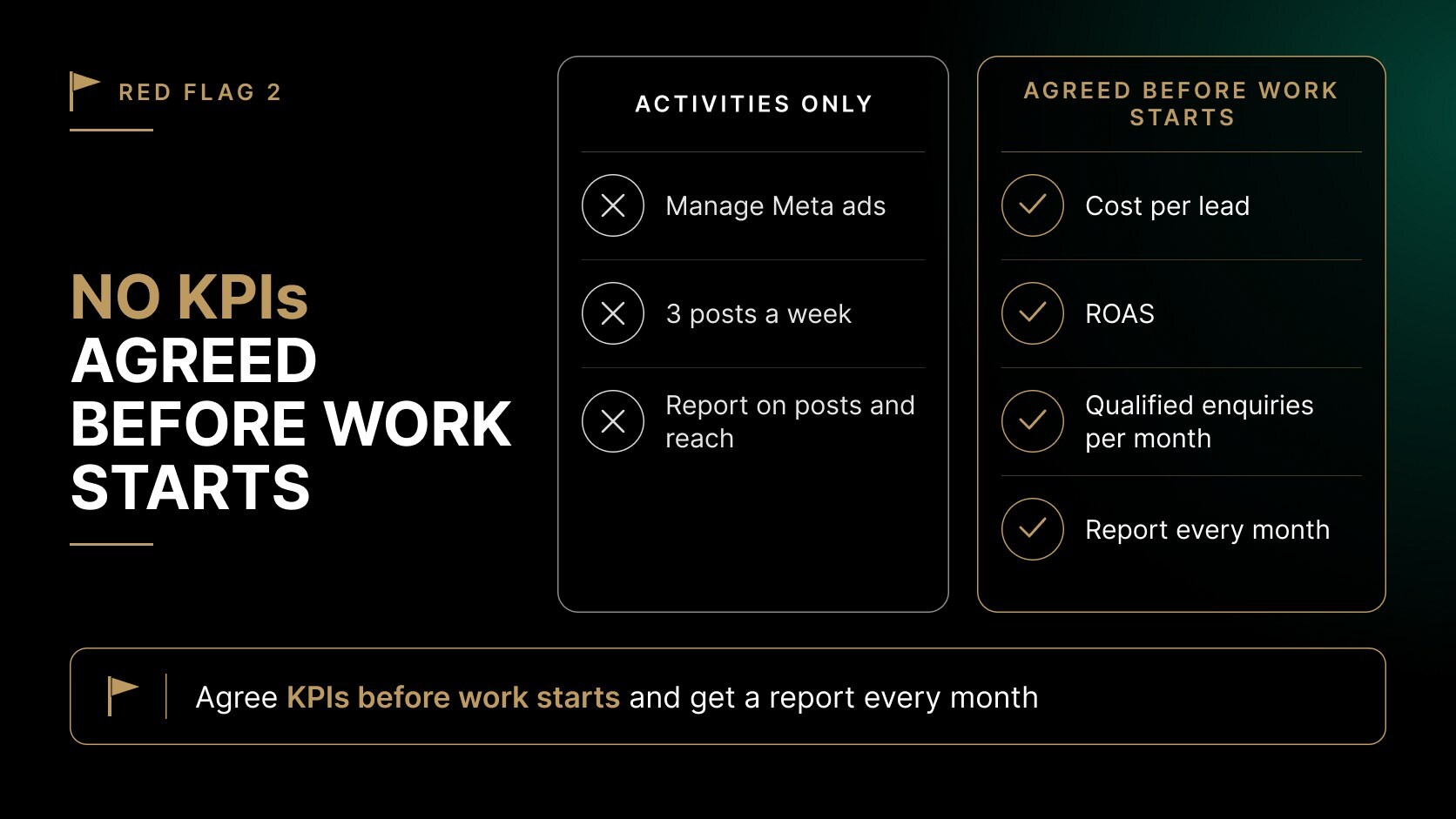
A proposal that lists services like "we will manage your Meta ads, post three times per week on Instagram, produce a monthly report" only describes what the agency will do. It does not explain what results those actions should achieve.
Before you sign, ask the agency which metrics you will agree on at the start and how often they will report on them. Also, ask what progress should look like at 30, 60, and 90 days.
If an agency cannot or will not answer this question clearly, they do not plan to report on results. You will pay for their time and effort with no clear way to see what it brings.
This matters for clarity. Agreeing on KPIs before work starts gives everyone a clear idea of what is working and what is not. Without them, disagreements about performance are bound to happen, and there is no clear way to settle them.
A good agency agrees a short list of specific, measurable KPIs with you before the first campaign starts and reports on them every month. Instead of vague goals like "increase awareness," the list should have clear numbers such as cost per lead, ROAS, or the number of qualified enquiries per month.
Red flag 3: They guarantee results
A guarantee sounds reassuring, so this one can seem surprising.
Marketing results depend on the agency's work and also on your offer, your prices, your market, how quickly your team answers enquiries, and how the sales conversation goes. An agency controls only part of that, so it cannot honestly promise a number of leads, sales, or a return on ad spend.
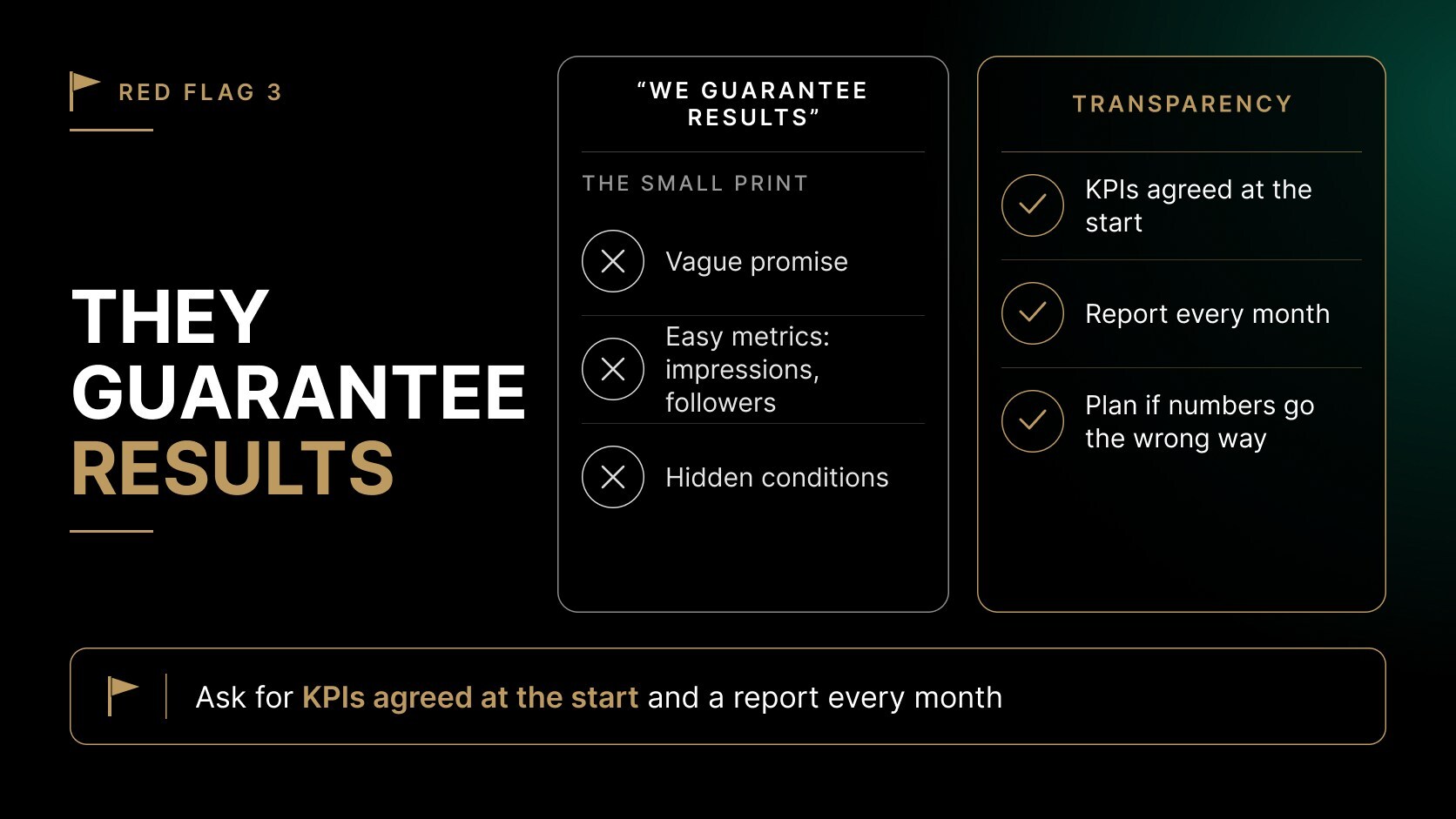
When an agency guarantees results anyway, look at the small print. The promise is usually vague ("you'll see results"), tied to a metric that is easy to move, such as impressions or followers, or wrapped in conditions that make it hard to claim.
Instead, a good agency agrees KPIs with you at the start, reports on them every month, explains what is working and what is not, and tells you what it will change when the numbers move the wrong way.
Red flag 4: Their reports focus on reach, impressions, and engagement
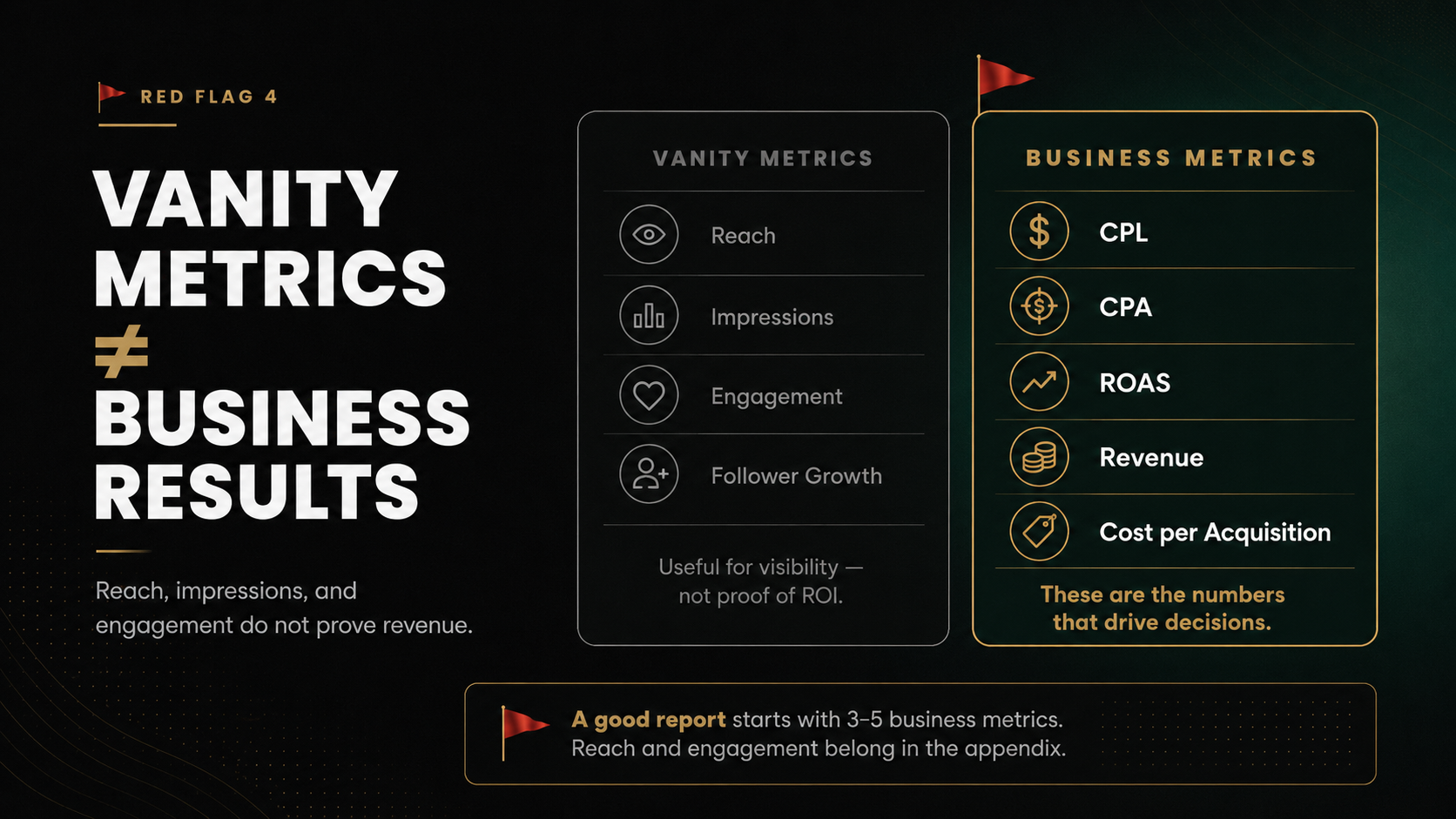
Before signing with any agency, ask to see a sample report. The way they organise the report will tell you a lot about how they work.
If a report starts with reach, impressions, follower growth, and engagement rate, it is measuring activity and visibility, not business results. These numbers have some value, but they are not what business owners need to make decisions. Impressions do not pay the bills.
The most important metrics are the ones that link marketing to revenue. These include cost per lead, cost per acquisition, return on ad spend, revenue from specific campaigns, and how these numbers change each month. Our guide on how to measure digital marketing performance includes a one-page scorecard you can ask for.
If an agency has never had a client request these metrics, they probably will not include them by default. Agencies that are confident in their results will highlight these numbers up front.
Recently, we saw a report that a social media agency sent to a flower shop. It only showed changes to the Instagram profile visuals. There was no cost per lead, no budget, and no business numbers.
A good report starts with three to five key business metrics. Reach and engagement can be found in an appendix if you want to see them, but they should not be the main proof that things are working.
Red flag 5: The person selling the work is not the person doing it
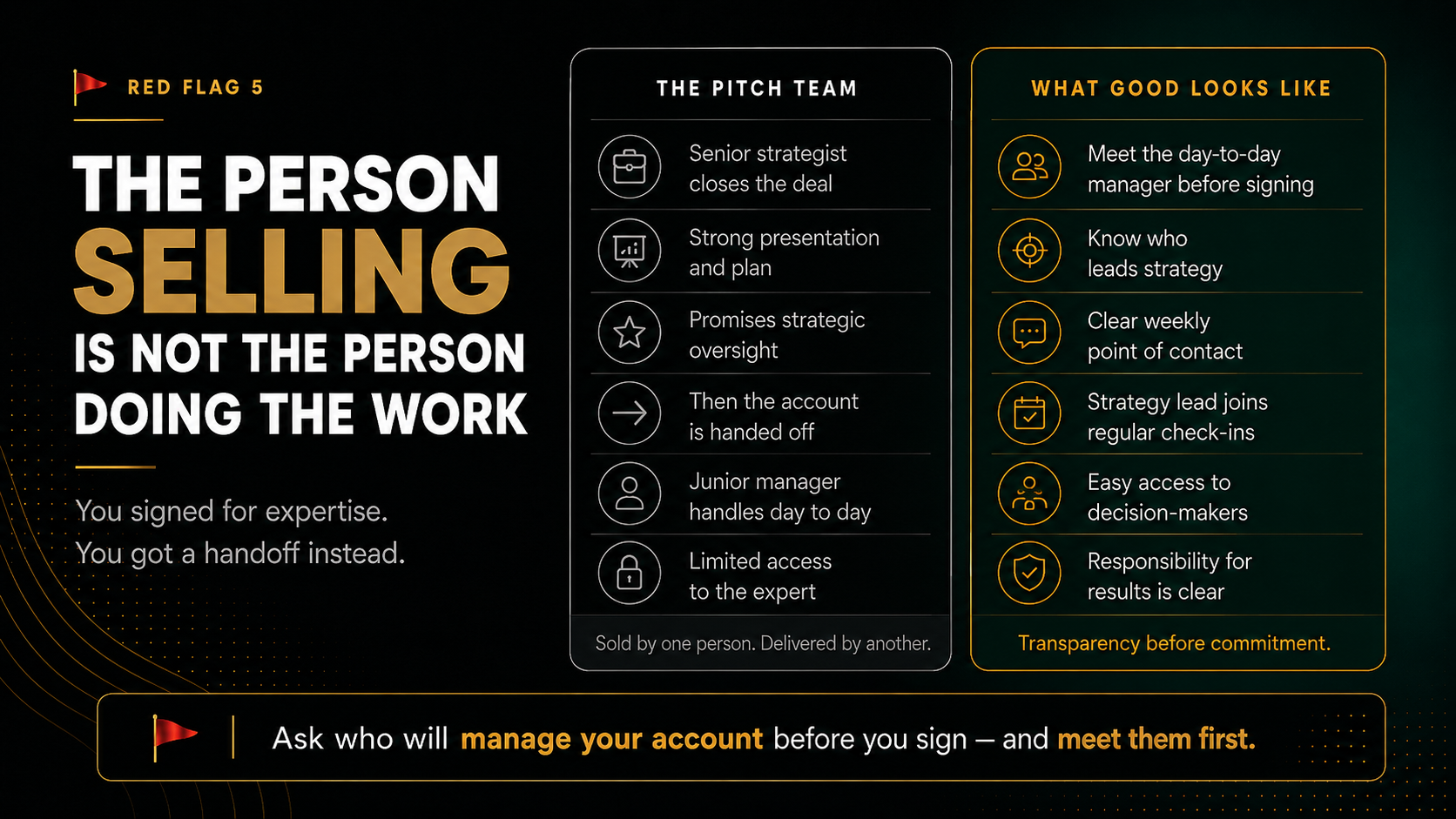
This is more common in larger agencies than in smaller ones, so it’s something you should be aware of before you sign.
In many agencies, senior strategists or founders handle new business, give the pitch, and present the plan. After you sign the contract, your account might be passed to a junior team. Sometimes, this could be someone with only eighteen months of experience who is also managing eight other clients.
This is not a problem if the agency is upfront about it. The real issue is when you are convinced to sign by someone whose expertise and strategic thinking you will rarely, if ever, interact with again.
Before you sign, ask clearly: Who will manage my account day to day? Who will I talk to each week? Who is in charge of strategy? If these are not the people you’ve already met, ask to meet them before you commit.
What good looks like: the person. Ideally, the person leading your strategy should be easy to contact, join regular check-ins, and explain the numbers in each monthly report.
Red flag 6: They cannot show you a case study with real numbers
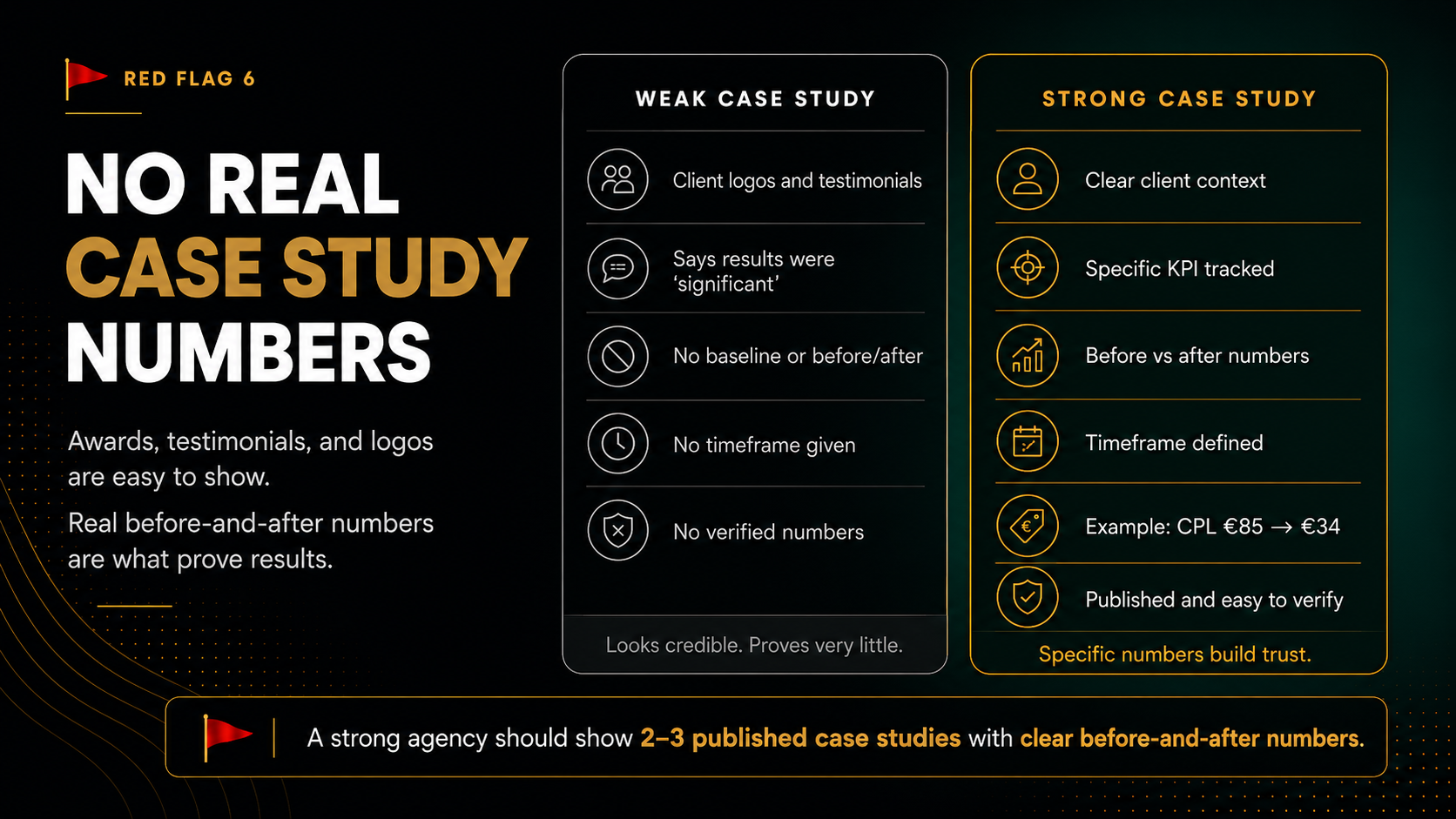
It’s easy to gather awards, testimonials, and client logos. Getting real, verified results is much harder.
If an agency has truly delivered measurable results, they can show you exactly what happened in a real project, using specific numbers. For example, instead of saying "we increased traffic significantly," they might say "we reduced cost per lead from €85 to €34 over 90 days for a wellness studio in London."
Being specific is important because it shows three things: the agency tracks results carefully, the client trusted them enough to share the numbers publicly, and the results are real, not just general trends.
If a case study does not include clear metrics, or if the agency cannot provide them when asked, it probably means the results were not tracked or were not worth sharing.
A strong agency will have at least two or three published case studies with clear before-and-after numbers.
Red flag 7: There is a long lock-in with no review point
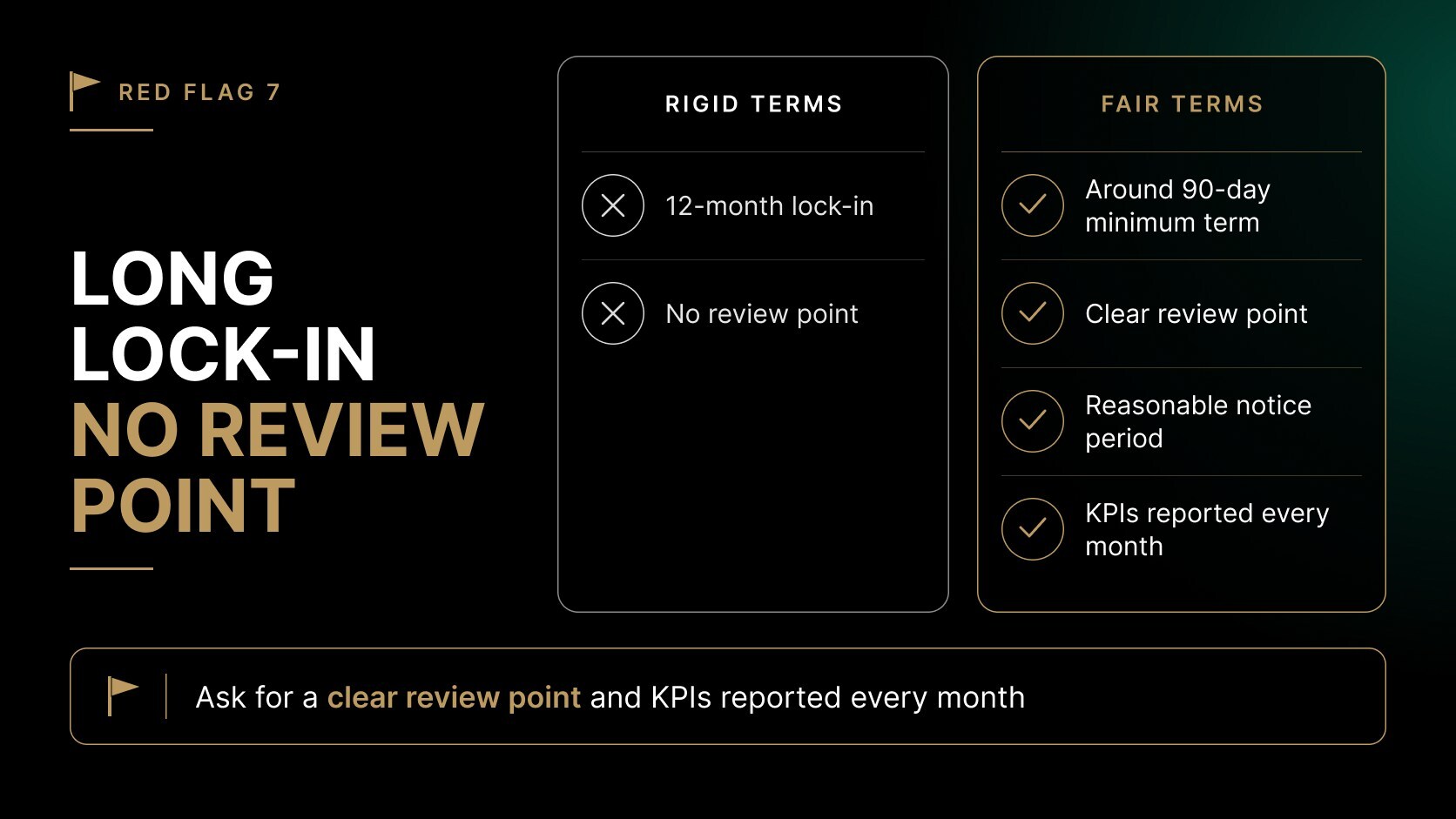
A 12-month contract with no review point and no way to leave early mainly protects the agency.
Minimum terms exist for good reasons. Meaningful marketing results take time, and a 30-day relationship does not give any agency enough time to build and optimise a campaign properly. For most channels, three months is a reasonable minimum.
However, a contract that makes you keep paying for 12 months, with no point at which you can review the work and decide whether to continue, puts all the risk on the client.
A fair contract has a minimum term of around 90 days, a clear review point, and a reasonable notice period after it. Alongside the contract, the KPIs are agreed at the start and reported on every month, so at the review point you decide with the numbers in front of you.
Red flags in the agency contract
The main contract red flags are ad accounts in the agency’s name, a scope without deliverables, promised results, and costs outside the fee. Flag 7 is about how long the contract lasts. Make sure to read the whole contract, since some clauses decide who stays in control if you and the agency split.
- The ad accounts are set up under the agency’s name. Your Google Ads, Meta Business Manager, analytics, and website should be yours, and the agency should just have access. If the agency owns the accounts, you lose all your history and data when you leave.
- The scope lists activities instead of clear deliverables. Phrases like “social media management” or “SEO support” don’t tell you much. The contract or its attached plan should spell out what you get each month, such as the number of posts, campaigns, and pages, and which reports you receive.
- Some contracts promise results. If you see a clause that guarantees a certain number of leads or a ranking, treat it as a sales pitch (see flag 3). KPIs should be in the plan you agree on at the start, with monthly reports on them.
- Some costs aren’t included in the main fee. Ask which tools, ad management fees, and extra hours will cost extra, and make sure you get the answer in writing.
When I built a social media department for a fintech and SaaS group, I set up KPI tracking and regular reporting as part of building the team. Expect the same from an agency: agree on what you’ll measure and how you’ll see it before starting the work.
Red flags by agency type: SEO, PPC, and branding
Each type of agency, including SEO, pay-per-click (PPC), and branding agencies, has its own warning signs in addition to the seven flags above.
SEO agency
- If an agency promises page-one rankings or a set amount of traffic by a certain date, be careful. Rankings depend on Google, and no agency controls them.
- If an agency reports traffic numbers but not enquiries, that’s a red flag. More visitors don’t always mean more customers. For example, a report can show impressions growing month after month while search clicks to the articles stay flat. A good SEO report shows both.
PPC (pay-per-click) agency: Google Ads and Meta Ads
- It runs your ads from its own ad account (see the contract section above).
- It reports clicks and click-through rate instead of cost per lead and sales.
- It cannot explain how its fee relates to your ad spend.
When I ran ads for a yacht-charter business, €350 in ad spend brought leads with an estimated booking value of €125,000. That figure is the estimated value of the enquiries before any booking was paid. A good PPC report separates the two and shows both.
Branding agency
- It shows you logos before it has asked about your customers and competitors.
- It has no step for positioning or messaging, only visual design.
- It does not hand over the source files and the rights to use them.
The question to ask before every agency conversation
One question stands out above the rest:
Which metrics will we agree on at the start, how will you report on them, and what will you change if they move the wrong way?
If an agency gives a clear answer, naming the metrics, how often you will see them, and how it will respond when results lag, it shows a level of transparency that most others lack. If it dodges the question or talks only about activity, that tells you something important too.
Look for an agency that is clear about what it will do and shows you the numbers every month.
A note on price
Choosing the cheapest agency usually isn’t your biggest risk. More often, the real problem comes from hiring a mid-range agency that charges professional fees but delivers poor results for several months before things fall apart.
Price shouldn’t be your main concern. What matters most is how specific an agency can be. If an agency can clearly explain what they will deliver, how they will measure progress, how often they will report, and what they will change if results fall behind, they are worth more than a cheaper agency that can’t answer these questions.
If you are currently evaluating agencies
If you’re a business owner looking for a marketing partner and want a second opinion on your options, we offer a free 45-minute intro call.
There’s no pressure to work with us. If another agency is a better fit, we’ll let you know. Feel free to bring any proposals you’d like to discuss.
You can book your intro call here: Book a free 45-minute intro call.
Frequently Asked Questions
What should I look for when hiring a marketing agency?
Focus on three main things: KPIs agreed before any work starts, monthly reports based on business results instead of just activities, and case studies with real numbers you can check. These signs tell you more about an agency than any presentation or client list.
Focus on three main things: KPIs agreed before any work starts, monthly reports based on business results instead of just activities, and case studies with real numbers you can check. These signs tell you more about an agency than any presentation or client list.
What are the biggest red flags when evaluating a marketing agency?
Watch out for these: no KPIs agreed before work starts, reports that focus on impressions and reach instead of cost per lead or revenue, no case studies with real numbers, guarantees of results, and contracts that lock you in for a year with no review point.
Watch out for these: no KPIs agreed before work starts, reports that focus on impressions and reach instead of cost per lead or revenue, no case studies with real numbers, guarantees of results, and contracts that lock you in for a year with no review point.
Is a marketing agency guarantee worth anything?
Be careful with guarantees. Results depend on your offer, your market, and your sales process as well as the agency's work, so no agency can honestly promise them. A better sign is an agency that agrees KPIs with you at the start, reports on them every month, and explains what it will change when the numbers move the wrong way.
Be careful with guarantees. Results depend on your offer, your market, and your sales process as well as the agency's work, so no agency can honestly promise them. A better sign is an agency that agrees KPIs with you at the start, reports on them every month, and explains what it will change when the numbers move the wrong way.
How long should a marketing agency contract be?
Three months is usually a good minimum for most marketing channels. This gives enough time to set up, launch, and start improving results. Longer contracts can make sense if the work is bigger, but they should include a review point and a reasonable notice period. A year-long contract with no review point puts all the risk on you.
Three months is usually a good minimum for most marketing channels. This gives enough time to set up, launch, and start improving results. Longer contracts can make sense if the work is bigger, but they should include a review point and a reasonable notice period. A year-long contract with no review point puts all the risk on you.
Should I ask to see case studies before hiring a marketing agency?
Yes, and don’t just look at the logos. Ask for case studies with clear before-and-after numbers, the client’s name, and details about what was done and why. If a case study only says things like "significantly improved results" without numbers, it doesn’t tell you much. Agencies that are proud of their work will share real details.
Yes, and don’t just look at the logos. Ask for case studies with clear before-and-after numbers, the client’s name, and details about what was done and why. If a case study only says things like "significantly improved results" without numbers, it doesn’t tell you much. Agencies that are proud of their work will share real details.
What questions should I ask a marketing agency before signing?
Ask these key questions: Which KPIs will we agree on at the start? Who will manage my account every day? Can I see a case study with real numbers from a business like mine? What will you change if results fall behind? How and how often will you report on performance?
Ask these key questions: Which KPIs will we agree on at the start? Who will manage my account every day? Can I see a case study with real numbers from a business like mine? What will you change if results fall behind? How and how often will you report on performance?
How do I know if a marketing agency’s pricing is fair?
Don’t judge by price alone. Instead, look at what’s included, how the agency will measure progress, and how often it will report. An agency that charges more but agrees clear KPIs with you and reports on them every month can end up costing less than a cheaper agency that gets no results after several months.
Don’t judge by price alone. Instead, look at what’s included, how the agency will measure progress, and how often it will report. An agency that charges more but agrees clear KPIs with you and reports on them every month can end up costing less than a cheaper agency that gets no results after several months.

Anastasia Boldurchidi is the founder of Integro Marketing Agency, a boutique marketing agency working with small and mid-sized businesses. She holds an MSc in Marketing from the University of Salford and has 10+ years of experience in marketing strategy, performance marketing and analytics.