

The majority of small businesses heavily rely on word-of-mouth. A friend mentioned your name, a past client made an introduction, someone found you at an event.
You continue to post something on social media, maybe run some ads, or send a few messages. Perhaps one client comes in. Three current ones leave at the same time.
The referral trap works until it doesn’t. Most business owners don’t have a lead and client generation system to fall back on.
This article is about building something more reliable than a word-of-mouth. A proper client pipeline that generates consistent interest in your business. No matter if someone mentioned your name last week or not.
Table of contents:
- The referral trap and why it eventually stops working
- What a client pipeline actually is
- The four stages every client goes through before buying
- The three channels that build a predictable pipeline
- Why most small businesses never fix their pipeline
- Where to start if you have no system at all
- Frequently Asked Questions
The referral trap and why it eventually stops working
One thing to remember is that referrals are not a marketing strategy. They are a byproduct of doing good work. There is a big difference.
A strategy is something you can control, predict, and improve. Referrals are none of those things. You cannot decide how many referrals you will receive next month. You cannot optimise them. You cannot scale them without first scaling the number of clients.
There are three specific moments when referral-only businesses tend to hit a wall:
When they want to grow faster than their existing network allows. A referral network has a ceiling. Once you've worked with everyone your current clients know, growth slows regardless of how good your work is.
When one or two anchor clients leave. If 60% of your revenue comes from clients who came through the same source, losing them also means losing that referral channel.
When they enter a new market or geography. A business that moves from Cyprus to serving UK clients has no existing referral network in London. Starting from zero without a system means starting from zero entirely.
None of this means that you shouldn’t provide work that people would love to recommend. However, you should stop treating referrals as a solid plan.
What a client pipeline actually is
A client pipeline is a set of processes that moves a person from not knowing anything about your business to become your paying (and returning) client.
It is measurable, repeatable, scalable, and does not depend only on one source.
Measurability is the key. The majority of small business owners keep in their mind who is interested, who might convert, and to whom shall the company do the follow-up. That’s all about memory. When something lives in your head, you cannot share it to other team members pr improve it, you cannot scale it.
A real pipeline always has certain stages. Each stage has numbers attached. It can clearly answer you questions like:
- How many people entered the pipeline last month?
- At which stage are most of them dropping off?
- How long does it typically take for a lead to convert to a client?
When you can answer those questions, you can fix things. When you can't, you're guessing.
The four stages every client goes through before buying
Before someone becomes your client, they move through four stages.
Importantly, different marketing activities serve different stages. When the stages and the activities do not match, marketing doesn’t seem to work. For example, instead of trying to close the cold audience for a strategic call, it’s more valuable to make them aware of the topic by providing content.
Let’s break down the stages.
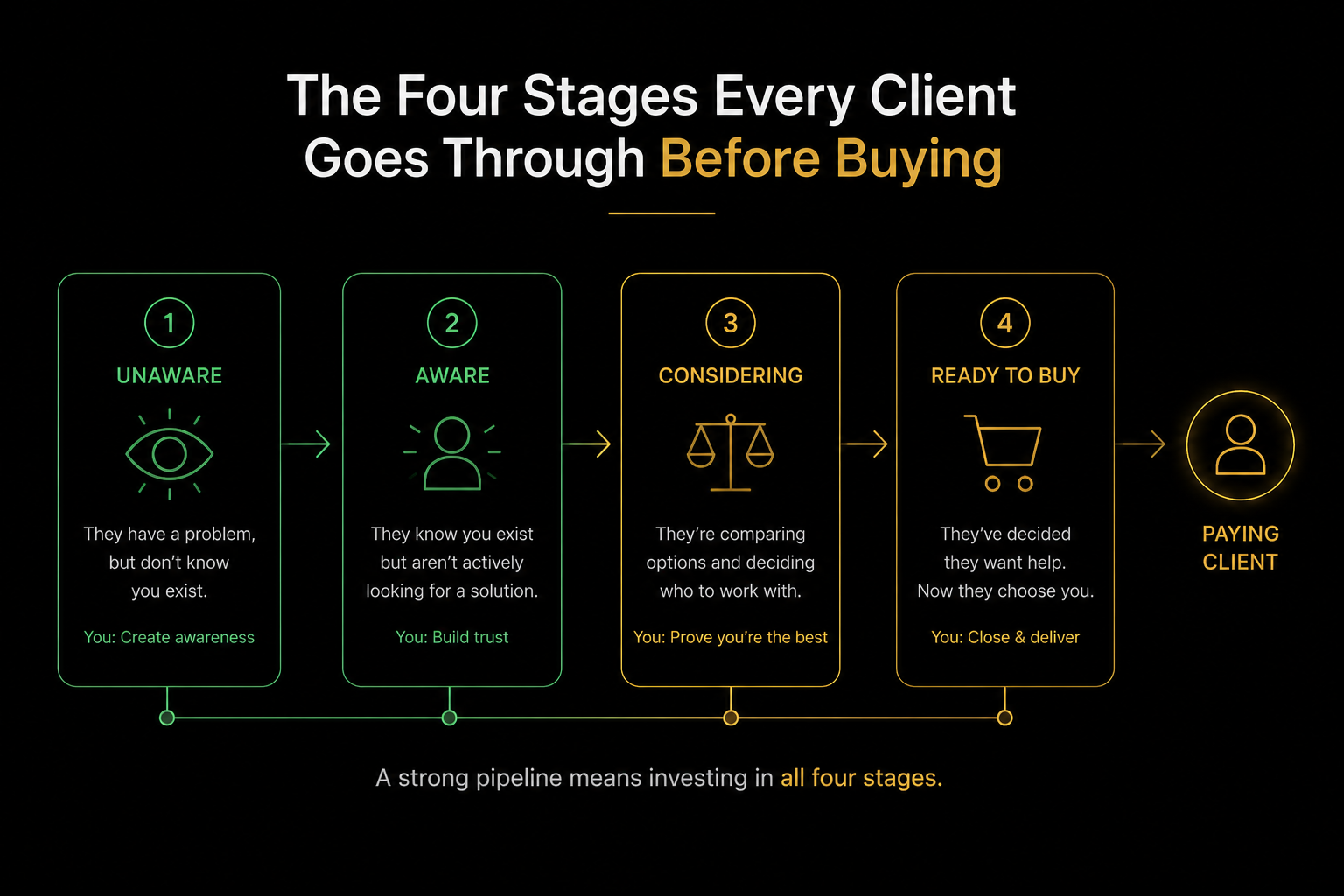
Stage 1 Unaware.
The person has the problem your business solves, but they don't know you exist. They may not even know the problem is solvable. At this stage, content and social media presence do the work: showing up in places where they spend time, building familiarity over time.
Stage 2 Aware.
They know your business exists, possibly they follow you or have read something you published. They are not actively looking for a solution yet. This is where consistent content, email newsletters, and social media presence keep you visible without being pushy.
Stage 3 Considering.
Something triggered the decision to look for help. It might have been a difficult month, a lost client, or a conversation. Now they are actively comparing options. At this stage, case studies, clear pricing, testimonials, and specific explanations of how you work become critical. This is when most businesses lose potential clients simply because the information isn't there.
Stage 4 Ready to buy.
They have decided they want to work with someone. The question is whether it will be you. Response time, how your first call goes, and whether your proposal addresses their specific situation - all affects the conversion.
Most small businesses only invest in Stage 4, that is the proposal, the close. But by Stage 4, the decision has mostly already been made based on what happened in Stages 1 through 3. Building a pipeline means investing in all four.
The three channels that build a predictable pipeline
There is no universal answer to which channel is right for your business. The majority of marketing specialists claim that these days it is crucial to be everywhere for better reach and recognition. However, it depends on your industry, your price point, your clients' behaviour, and how much budget and time you have. There are three channels that can consistently drive new clients in, if done correctly.
Paid advertising for immediate, measurable lead flow
Paid ads on Meta (Facebook and Instagram) or Google are the only channel that can generate leads predictably from day one. However, if your marketing specialists do not spend time to understand your audience, do not develop the clear offer, or do not set up the technical part correctly, you will spend all your marketing budget with no results.
When paid advertising works, you can easily measure the cost per lead and scale the campaigns accordingly.
When paid advertising works, it works because you can measure cost per lead directly and optimise it. For example, a B2B consulting company spends €1,000 on LinkedIn Ads and gets 20 enquiries. That makes the cost per lead €50. Next month, they test a new set of creatives, focusing on the specific pain point. With the same budget they now receive 30 enquiries. Now they know something useful for their pipeline.
Best for: businesses that have an offer, need leads quickly, have a monthly ad budget of at least €500–800, and have a clear offer with a defined audience.
Content and SEO for long-term pipeline growth
All types of content, such as articles, case studies, short-form videos, and more, work in a different way. Social media content requires more time as it heavily relies on platforms’ algorithms and builds trust and raises awareness of the issues your potential clients may have.
SEOand website content attracts business owners who are in active search of their problem solution. However, it also takes time (even longer than social media), because of the technical part. For example, a new domain will not rank in the first month. Search engines need to start crawling. Overall, it may take from 4 to 6 months of consistent posting to start seeing some results. The good thing is SEO has the compound effect: the article published today will continue to bring traffic (and clients) for years. With no additional cost.
The combination of paid advertising and content efforts are better used together, as they compliment each other. While paid ads generate instant leads, the content may reduce cost per lead and build long-term visibility.
Best for: businesses with a 12+ month horizon, consistent publishing capacity (one article every two weeks is enough to start), and topics their clients actively search for.
Referral systems for turning good work into structured growth
Meanwhile, you shouldn’t leave the idea of referrals. Instead of relying on random mentions, you can build the system you can actually measure. The difference between the chaotic referrals and the measurable system is one: asking.
Most satisfied clients would refer to someone if asked at the right moment. Most businesses never ask. A referral system is the practice of consistently asking with adding a small incentive - a discount or a thank-you gift.
If you want to bring your referral system to the next level, you can always have the partnerships agreements ready. That is, you pay the commission for every client your partner brings you.
Best for: every business, at every stage. This is the lowest-cost lead channel available and the only one that should never stop running.
Why most small businesses never fix their pipeline
The majority of business owners do not think of their pipeline until they face some challenges or they want to scale. The four stage process becomes almost invisible when the clients are coming and there is too much work to do. The pipeline issue becomes obvious in the quiet months.
Another reason is that pipeline building requires doing things that don’t produce immediate results. Writing an article, shooting a YouTube video, publishing content on Instagram. None of this can generate a client tomorrow. For most businesses investing time and budgets in activities with 6+ month return is challenging to prioritise.
The third reason (the one we can see most often) is that most business owners have already tried something and didn’t get the result they were expecting. In the end of the day, the conclusion is simple: "marketing doesn’t work for my business." In those cases, there are always some issues behind the channel. For example, the restaurant might not have an offer for the potential customers and the urgency to come in their ad and the ad was run for 1-3 days, which is not enough for META to complete the learning phase.
The businesses that build reliable pipelines are usually not doing anything dramatically different. They are just doing fewer things, more consistently, with better tracking.
Where to start if you have no system at all
The most effective starting point is almost always the same: fix your tracking before you spend anything on new channels.
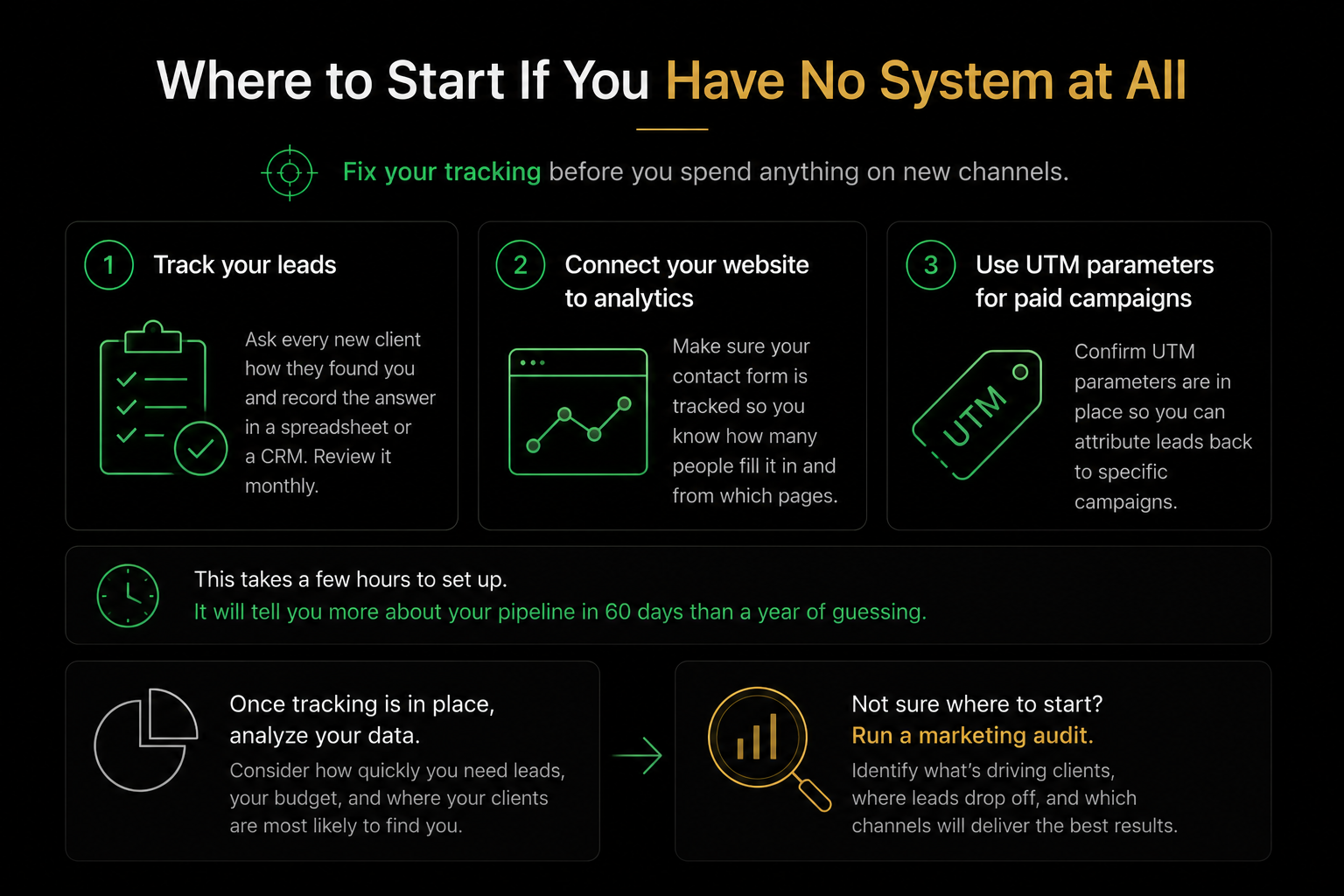
Before running ads, before publishing content, before anything else, set up the ability to know where your clients are coming from. This means:
- Asking every new client how they found you, and recording the answer somewhere you can review it monthly. Never in your memory. In a spreadsheet or a CRM.
- Making sure your website contact form is connected to analytics, so you know how many people fill it in and from which pages.
- If you are running any paid campaigns, confirming that UTM parameters are in place so you can attribute leads back to specific campaigns.
This takes a few hours to set up. It will tell you more about your pipeline in 60 days than a year of guessing.
Once you have tracking and analytics in place, the next decision is which channel to invest in based on your specific situation. Analyze how quickly you need leads, what your budget allows, and where your clients are most likely to find you.
If you are not sure where to start, a structured marketing audit is usually the fastest way to get a clear picture.
It looks at what is currently driving clients to your business, where leads are dropping off, and which channels are most likely to produce results given your specific situation.
If you'd like a clearer picture of your current pipeline
We offer a 30-minute free consultation to see what can be your next steps in understanding your marketing setup.
After a 30-minutes call you will understand what to do next, which metrics to check and what channels will perform better for your business.
You can book a time directly on the Integro contact page or on Calendly.
Frequently Asked Questions
What is a client pipeline for a small business?
A client pipeline is the process that moves a person from not knowing anything about your business to becoming a paying (and returning) client. A working pipeline is measurable at each stage. You know how many people enter, where they drop off, and what it costs to acquire each new client. Without measurement, a pipeline is just a set of activities with no possibility for scale.
A client pipeline is the process that moves a person from not knowing anything about your business to becoming a paying (and returning) client. A working pipeline is measurable at each stage. You know how many people enter, where they drop off, and what it costs to acquire each new client. Without measurement, a pipeline is just a set of activities with no possibility for scale.
How long does it take to build a consistent client pipeline?
It depends on the channel. Paid advertising can generate leads within two to four weeks if campaigns are set up correctly. SEO and content marketing typically take four to nine months. A referral system can start generating results in weeks if you have existing clients and simply begin asking consistently. Most reliable pipelines combine two or three channels rather than relying on one.
It depends on the channel. Paid advertising can generate leads within two to four weeks if campaigns are set up correctly. SEO and content marketing typically take four to nine months. A referral system can start generating results in weeks if you have existing clients and simply begin asking consistently. Most reliable pipelines combine two or three channels rather than relying on one.
Why is relying only on referrals a problem?
Referrals cannot be controlled, predicted, or scaled independently of your existing client base. They work well as a supplementary channel but not as a primary growth strategy, especially if you want to grow into new markets, replace churned clients quickly, or plan revenue more than a month ahead.
Referrals cannot be controlled, predicted, or scaled independently of your existing client base. They work well as a supplementary channel but not as a primary growth strategy, especially if you want to grow into new markets, replace churned clients quickly, or plan revenue more than a month ahead.
How much should a small business spend on lead generation?
A commonly used benchmark is 5–10% of revenue reinvested in marketing. For a business generating €10,000 per month, that is €500–1,000. At the lower end of that range, a paid social campaign plus basic content is achievable. Always remember to track your cost per lead. Without it, you won’t be able to know what works for your business.
A commonly used benchmark is 5–10% of revenue reinvested in marketing. For a business generating €10,000 per month, that is €500–1,000. At the lower end of that range, a paid social campaign plus basic content is achievable. Always remember to track your cost per lead. Without it, you won’t be able to know what works for your business.
What is the fastest way to get more clients for a small business?
The fastest channel is usually a combination of direct outreach to your existing network and a simple paid campaign targeting a specific, well-defined audience. Neither requires months of setup. The limiting factor is usually the offer. A specific, clearly communicated offer to a clearly defined audience converts faster than a generic one.
The fastest channel is usually a combination of direct outreach to your existing network and a simple paid campaign targeting a specific, well-defined audience. Neither requires months of setup. The limiting factor is usually the offer. A specific, clearly communicated offer to a clearly defined audience converts faster than a generic one.
What is the difference between lead generation and a sales pipeline?
Lead generation is the process of getting people to enquire, contact you, or book a call. A sales pipeline covers what happens after that: how you move interested leads toward becoming paying clients.
Lead generation is the process of getting people to enquire, contact you, or book a call. A sales pipeline covers what happens after that: how you move interested leads toward becoming paying clients.
How do I know if my marketing is generating a consistent pipeline?
Track three numbers monthly: number of new enquiries, cost per enquiry, and how many convert to paying clients. If all three are stable or improving, your pipeline is working. If enquiry volume is inconsistent, the top of your pipeline needs attention. If enquiries are coming in but not converting, the issue is further down, in how you handle leads once they arrive.
Track three numbers monthly: number of new enquiries, cost per enquiry, and how many convert to paying clients. If all three are stable or improving, your pipeline is working. If enquiry volume is inconsistent, the top of your pipeline needs attention. If enquiries are coming in but not converting, the issue is further down, in how you handle leads once they arrive.

Anastasia Boldurchidi - Master of Science in Marketing, a speaker, an author of two academic dissertations, and the founder of Integro Marketing Agency, a boutique marketing agency working with SMB owners across Europe. She has 10+ years of experience in digital marketing and has managed campaigns generating over €1 billion in client revenue.