
So you hired a freelancer or a marketing agency. As the first month finishes, you get the report.
Impressions? Reach? Follower growth?
Looks professional. Looks like something is happening.
But is your marketing making you money?
Most business owners can’t answer this question. The reason is simple: no one ever showed them which numbers actually matter.
This guide will change that.
Table of contents:
- Why most marketing reports tell you almost nothing?
- What marketing ROI actually means?
- The three numbers that actually matter
- How to set up attribution? The part most businesses skip
- What to look for in your monthly report?
- Where to start?
- If you'd like to dive deeper into your marketing
- Frequently Asked Questions
Why most marketing reports tell you almost nothing
Most agencies follow the same pattern when it comes to reporting. For example, the reports usually include lots of graphics, reach numbers, and screenshots of posts which performed well.
They focus on activity rather than the result. They can’t say what actually changed in your business because of their activity.
Getting 1 million views on one reel on Instagram doesn’t mean you get more leads and calls. A 30% increase in website traffic doesn’t mean you get more paying clients.
In our early years we had that issue. We drove 15,000 thousand people to the main website. None of them registered. Traffic increased, but not registrations or sales. What have we changed? Simply the technical part of the META ads. The next week we got 2,000 unique visitors and 314 registrations, some of them resulting in sales.
So for us ROI is more important than the activities and meaningless numbers.
The first step toward measuring marketing ROI properly is deciding to stop accepting activity as a substitute for results.
What marketing ROI actually means
ROI stands for Return On Investment.
Talking marketing, it's the relationship between what you spend and what you get back in revenue.
The basic formula looks like this:
Marketing ROI = (Revenue attributed to marketing − Marketing costs) ÷ Marketing costs × 100
So if you spent €2,000 on ads and the campaigns generated €8,000 in new client revenue, your ROI is 300%. For every euro you invested, you got four back.
This sounds simple.
But the majority of small businesses don’t have a clear way to understand which marketing activities bring revenue back.
We’ll fix that.
The three numbers that actually matter
You don’t need complex models. All you need is to remember three key metrics every business owner should track.
It doesn’t matter what your industry or budget is, or which marketing channels you’re using.
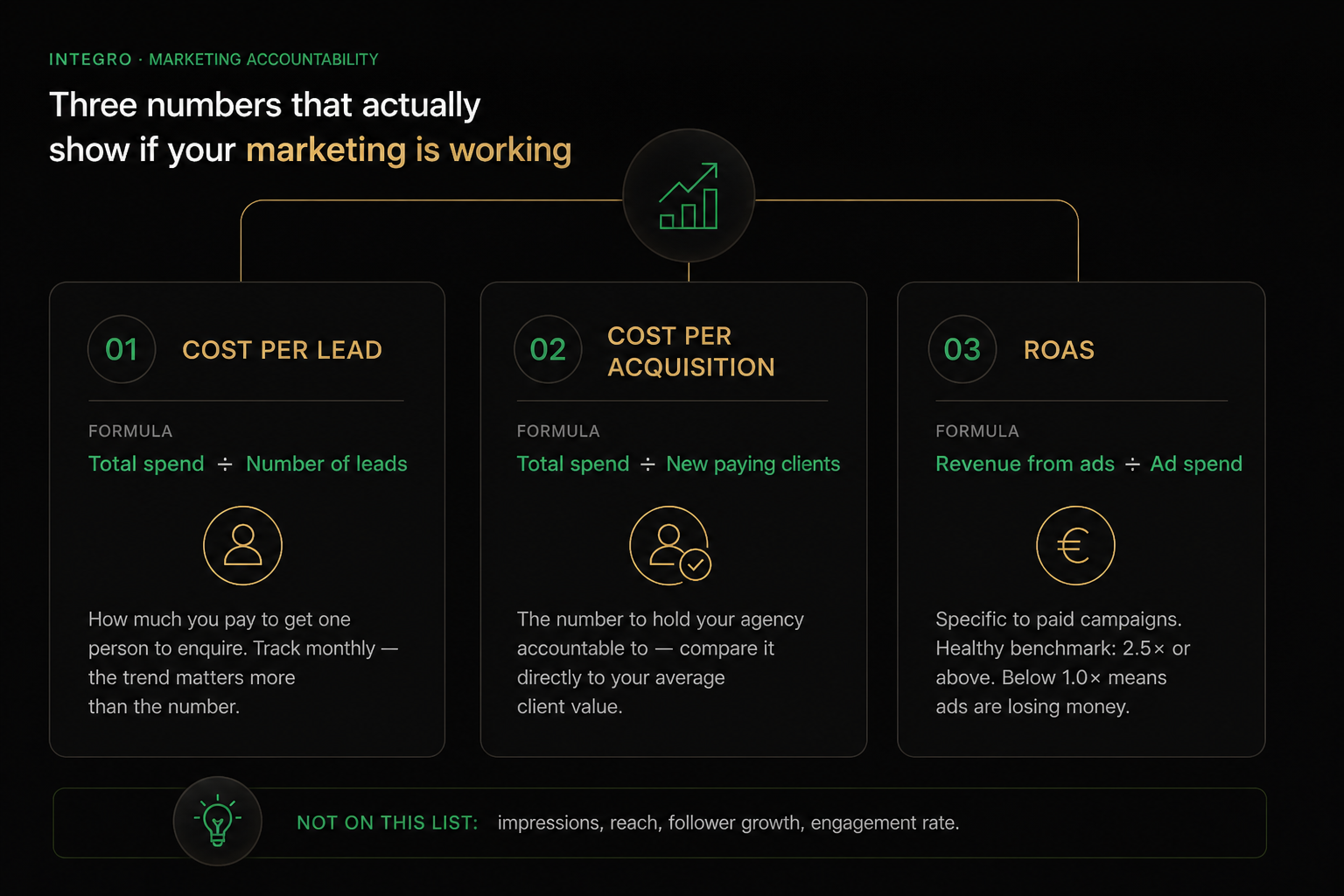
1. Cost per lead (CPL)
This tells you how much you are paying for the potential customer to contact you - to send a direct message, to give a call, to fill a form, or to book a consultation.
CPL = Total marketing spend ÷ Number of leads
If you spent €1,000 on Meta ads last month and got 25 enquiries, your cost per lead is €40.
Comparing CPL overtime with different marketing activities gives your the understanding of what worked well and what didn’t.
For example, for one of the B2B companies we launched LinkedIn Ads and our CPL was 150$. The following week we tested a local networking event. The ticket cost was 70$, and the business development manager generated 7 qualified leads. This made the CPL just 10$ per lead. As a result, we understood that local networking was more cost-effective in this case.
2. Cost per acquisition (CPA)
This is how much it costs you to get one paying client.
CPA = Total marketing spend ÷ Number of new clients
Once we managed 1,200$ monthly budget on META ads for the beauty studio. That month we generated 60 enquiries, out of which 12 because paying clients.
This brought CPA to 100$ per client.
In other words, if you spent 1,000$ and got 25 leads, 5 of which became your clients, your CPA is 200$.
Now that’s the number of your business. Not the followers count.
When you know your CPA, you can compare it with your average client value.
3. ROAS (return on ad spend)
ROAS is specific to paid advertising.
It measures how much revenue was generated for every euro spent on ads.
ROAS = Revenue from ads ÷ Ad spend
A ROAS of 3.0 means you made €3 for every €1 spent on advertising.
For most industries, a ROAS above 2.5-3.0 is a sign your campaigns are working.
Below 1.0 means you're losing money on ads.
Note: ROAS measures the return on the ad budget itself, not your total marketing spend. It should be counted with CPL and CPA, without replacing them.
How to set up attribution? The part most businesses skip
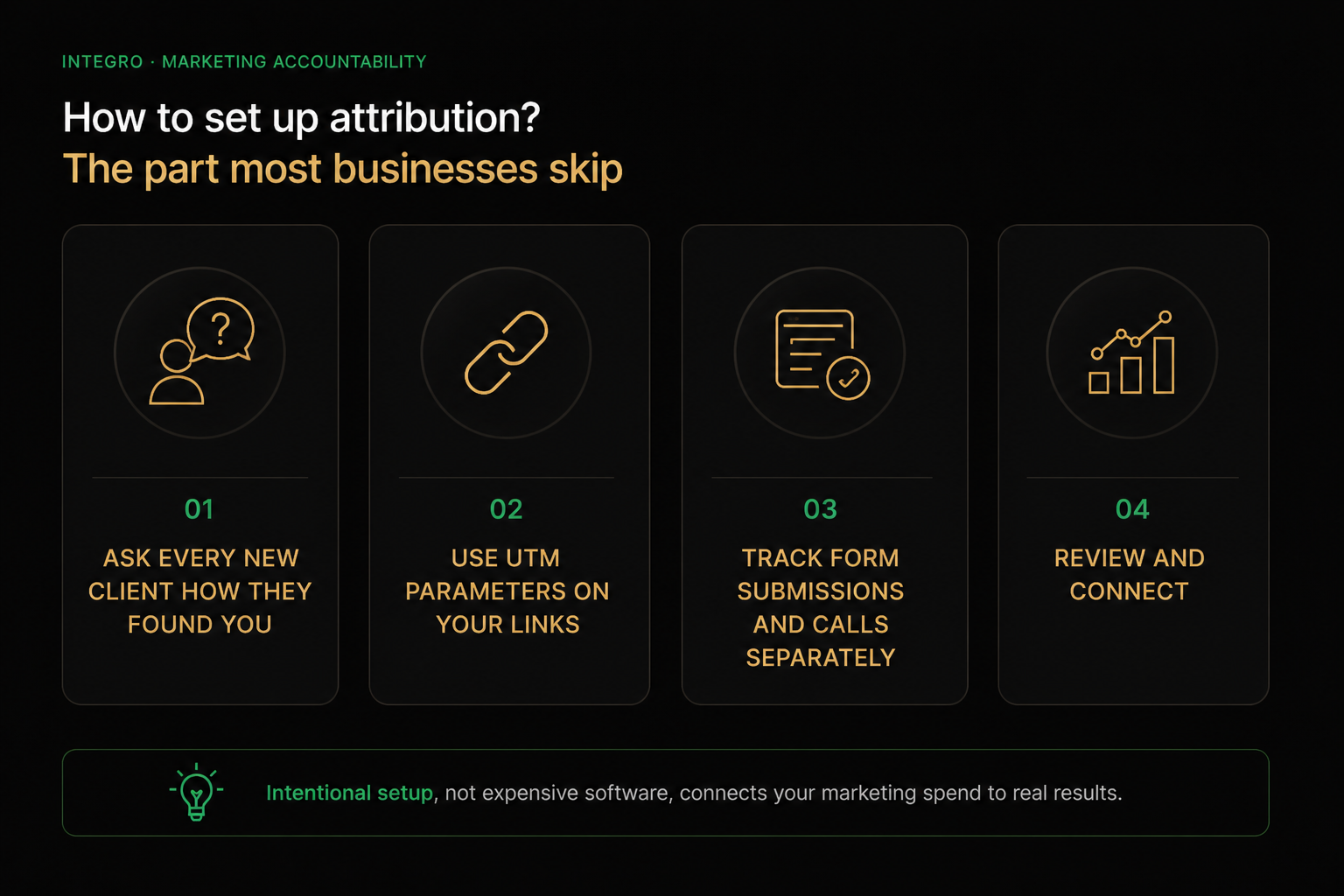
Attribution is when you can answer: how did this client find me?
Always track your marketing channels, because without it you continue to rely on guesswork. Moreover, when the next marketing specialist comes to your company, asking where do you get your clients from, you will simply say: "I don’t know. Probably the word-of-mouth"
It’s not data you can rely on.
Here's a simple system that works for most small businesses:
Ask every new client how they found you. Make it a part of your selling call or onboarding process, wherever your first capture their information. Match the options with your actual channels, for example, Instagram ad, Google search, LinkedIn and so on.
This will give you qualitative attribution. Imperfect. But better than nothing.
Use UTM parameters on your links. Every link there is in your digital marketing should have a UTM tag. It’s the specific link which tells Google Analytics which campaign, platform, or ad creative drove a visitor to your website or landing page. Your marketing specialists should do that already. If they don’t, ask why.
Track form submissions and calls separately. If there is a contact form on your website, you need to know how many submissions come each month. And from which pages. Apart of that, if calls are an important conversion factor, then use a call tracking number for your ads.
The most interesting thing is that none of it is difficult or expensive to setup. Yet, the majority of small businesses never do that. As a result, they wonder why they can’t connect marketing spend with business results.
What to look for in your monthly report
Now, here is the most interesting part: what should you ask for in the marketing report.
Well, a good marketing report will always answer three main questions:
1. How much did we spend, and what did we get?
This means actual revenue or qualified leads. Forget about impressions and reach.
2. Is performance improving, staying the same, or declining compared to last month (last week)?
Always see what the metrics were before and after. Trends matter more than a single number. 50$ CPL can be good or terrible based on whether it was 80$ or 30$ last month.
3. What are we changing next month, and why?
Marketing is not something you can set up one time and that’s it. It always has a cyclic nature. The report should represent that: what new knowledge we’ve got, what is going to be stopped, what are we going to optimize, what is our result forecast for the next month.
If you current monthly reports don’t answer these questions, then ask your specialist why. A good report is built to drive decisions and future business results.
Where to start?
Don’t worry if you don’t track any of these numbers. Here’s what you can do next week:
- Begin with one number, for example, CPL. Just look what you spent on marketing channels last month, count how many leads you’ve got. Divide one by the other.
- Next month, do it again. See if there are any changes.
One real number can tell you more about what's happening in your marketing, than a perfectly designed report.
If you'd like to dive deeper into your marketing
We offer a 30-minute free consultation to see what can be your next steps in understanding your marketing setup.
After a 30-minutes call you will understand what to do next, which metrics to check and what channels will perform better for your business.
No package recommendations unless you ask.
You can book a time directly on Integro Website form or on Calendly.
Frequently Asked Questions
What is a good marketing ROI for a small business?
A benchmark you can use is 3:1 return. That is, for every 1$ spent on marketing, you get 3$ generated in revenue. However, it all depends on your industry, margins and on time in which the client converts.
The more important question is whether your ROI is improving month by month.
What's the difference between ROAS and ROI?
ROAS measures the return on your ad spend specifically. ROI measures the return on your total marketing investment, including agency fees, content costs, and tools.
How do I know if my marketing agency is performing well?
The best sign is if they consistently report on CPL, CPA, and ROAS. A good agency should tell you exactly which marketing channel performs best in terms of number of leads and their cost.
Can I measure marketing ROI without running paid ads?
Of course. However, it might require a bit more time and effort. For example, for organic channels like SEO you can track form submissions, or how leads describe finding you. The attribution is still possible.
How long before marketing shows a return?
It highly depends on the marketing channel. Content marketing and SEO typically take 4-9 months to produce organic traffic. Paid advertising can take up to 1-2 weeks.
What should I do if my agency can't tell me my cost per lead?
First stop paid marketing campaigns until you know the outcome of the previous ones. That’s how you save your budget. Secondly, ask your agency to provide the necessary metrics. If they can’t, it means either there is no proper tracking setup, or there is no data to support the clear answer.

Anastasia Boldurchidi - Master of Science in Marketing, a speaker, an author of two academic dissertations, and the founder of Integro Marketing Agency, a boutique marketing agency working with SMB owners across Europe. She has 10+ years of experience in digital marketing and has managed campaigns generating over €1 billion in client revenue.